A feast with Satyrs: from Venice to the southern Netherlands
Remarkable discoveries in 'The Banquet' by Francesco di Girolamo da Santacroce
Remarkable discoveries in 'The Banquet' by Francesco di Girolamo da Santacroce
The Bonnefanten Museum has a unique painting in their collection attributed to Francesco di Girolamo da Santacroce (1516-1584). The Banquet depicts a mixed group of people seated at a round table, who, as the title suggests, are enjoying a sumptuous meal. The costumes, the colourful palette and the arcade in the background reveal that this is a typical Italian Renaissance painting. Yet a fundamental element of this painting is missing: the exact subject. In the foreground are eight satyrs, mythological creatures that are half-human and half-goat. This probably means that this is a mythological scene, but which one? A master's student at Utrecht University, Thel van Dijk, delved into this piece and made some remarkable discoveries.
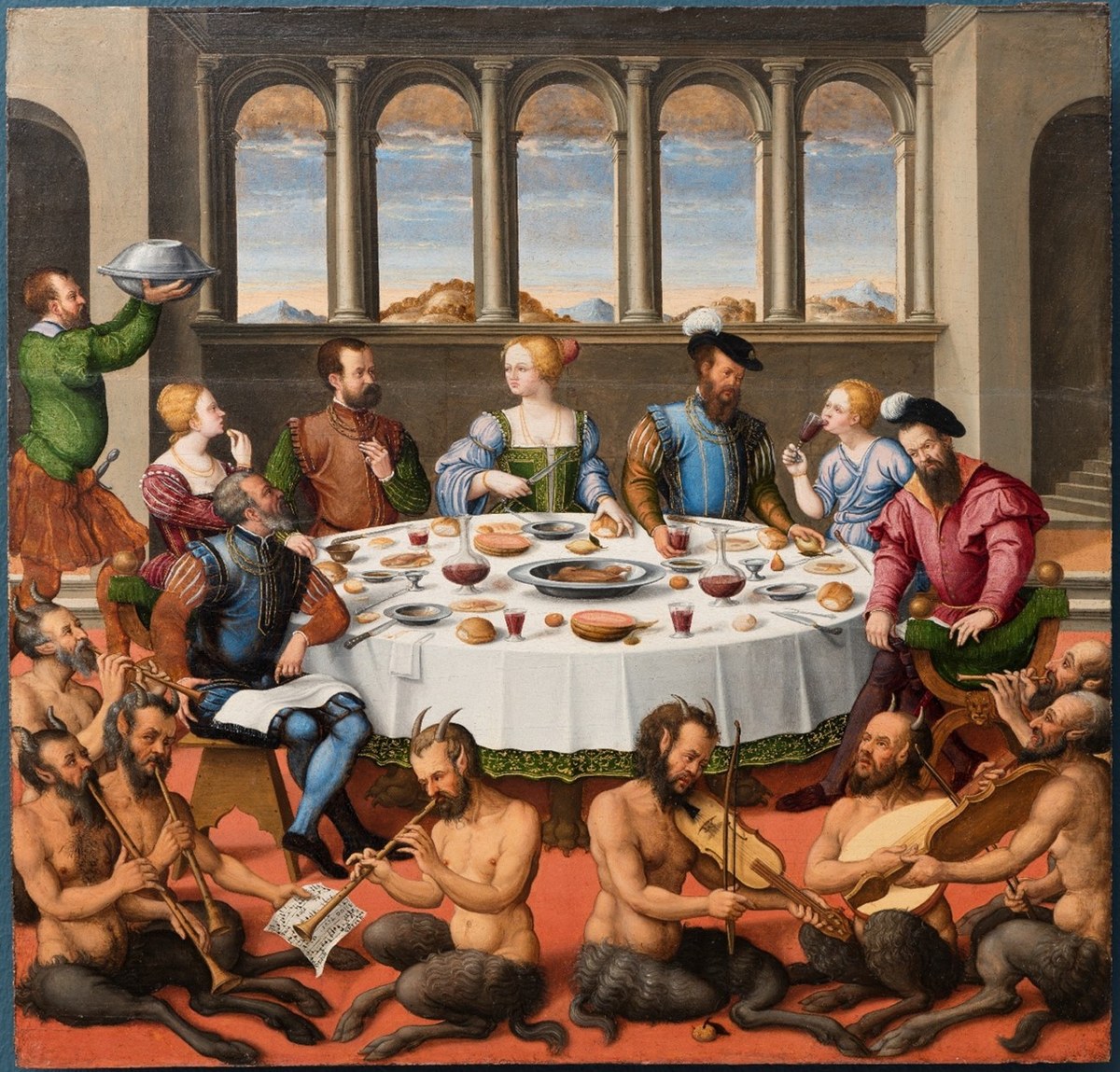
Francesco di Girolamo da Santacroce (?), Banquet, c. 1540, Bonnefanten Collection, long-term loan from RCE. This artwork belongs to the collection Nederlands Kunstbezit (NK-Collection). This collection consists of art objects that were recovered from Germany by the Allies after the Second World War and subsequently came under the management of the Dutch State. The collection contains objects that may have been looted, confiscated or sold under duress between 1933 and 1945. More information can be found at wo2.collectienederland.nl. If you have any information about this artwork, please contact restitutie@cultureelerfgoed.nl. This may help us in our search for the rightful owner.
You're never too young to learn
Francesco learned the art of painting from his father, Girolamo da Santacroce (c. 1500-1556), who had a studio in Venice. The works of Francesco and his father show similarities in style. For example, John the Baptist in Girolamo da Santacroce's painting, also in the Bonnefanten Museum, is reminiscent of the figures in Francesco's Banquet. The expressions on the faces of the figures are similar, including the small eyes and high foreheads. His father's influence is also confirmed by the composition of the table and the figures around it. The round table, the tablecloth and the positioning of the objects are very similar to depictions of The Last Supper by Girolamo da Santacroce and his teacher Francesco Rizzo in Venetian churches.
_-_Ultima_cena_di_Francesco_Rizzo_da_Santacroce.jpg)
Enigmatic banquet
Art historian De Jong-Janssen interpreted the scene in a 1995 catalogue as an “allegory of worldly love”. She probably based this on the sheet music in the hand of one of the satyrs, which bears the following text: “Only you, my love, give me hope”. Another “allegory of love” has also turned up in Francesco's studio. However, that work depicts Cupid: a more accessible representation of this subject. This discovery makes the scene with the meal with satyrs as an allegory of love even more enigmatic.
The music-making satyrs
The addition of the satyrs at the banquet make this work particularly mysterious. In Venetian art, satyrs often appear in depictions of feasts, such as Bacchanals (exuberant celebrations in honour of the wine god Bacchus), but then as active revellers, as seen in the work of contemporary Andrea Mantegna (1431-1506). In The Banquet, however, they are not part of the feasting and eating company, but calmly provide the music in the foreground. They play shepherd's flutes, violins and a lute. The latter instrument is a striking choice: in art from this period, satyrs often play the flute and violin, but not the lute. In the sixteenth century, the lute was seen as an earthly instrument and did not feature in mythological narratives, in which stories about classical gods were told.

However, a sixteenth-century Venetian lute book, the Capirola Lute Book, provides a link between the lute, sheet music and satyrs. The sheet music book is decorated with illustrations of plants, animals and a few satyrs. The sixteenth-century interpretation of satyrs playing music at a meal is difficult to reconstruct.
Southern Dutch influence?
In the sixteenth century, there was a great deal of exchange between artists from the southern Netherlands and the Venetian art market. The painter of The Feast may have found inspiration in this southern Dutch tradition. Around the same time, the Antwerp artists Pourbus painted similar dinner scenes with musical instruments. Frans Pourbus the Elder (1545-1581) depicted a lute and sheet music at a meal. His son Pieter Pourbus (c. 1523-1584) painted an Allegory of True Love with a banquet featuring instruments.
The Feast can be seen as a unique Venetian genre piece, in which the painter probably drew his inspiration from Venetian associations between satyrs, sheet music and the lute on the one hand, and Southern Dutch dinner scenes or tales of love on the other.
Written by Thel van Dijk, MA alumnus in Art History at University of Utrecht.